
Image Frances Rivetti
After a quarter of a century of neglect, the ruin that is the dilapidated Petaluma Trestle is turning 100.
If ambitious efforts back in 2013 to rehabilitate the Trestle for pedestrian access and bring it back to life had been successful, instead of looking at this wire-fenced shocker of a train track wreck, a transformed waterfront park in the heart of the city’s downtown historic district would’ve taken its place.
Not surprisingly, there are no public plans for an open-air Historic Downtown Rail Trestle Centenary celebration to commemorate the golden era of Petaluma’s riverfront history this spring or summer.
Instead, to quote the New York Times in a recent article on majestically moldering rail stations, the Petaluma Trestle continues to be similarly and shamefully “slowly crushed by the boot of time”.
But it’s not too late for revitalization. In fact, it’s high time this eyesore is given the love and attention it deserves.
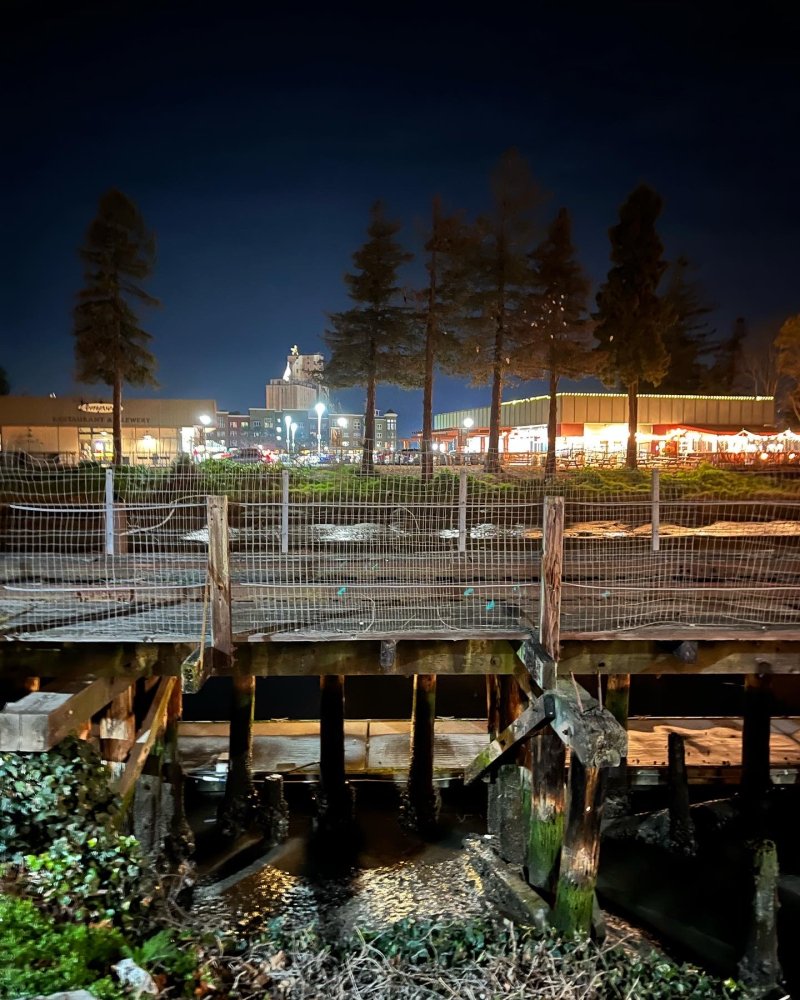
Image Frances Rivetti
And as more Petalumans rally to speak up in support for a rehabilitation of the Trestle and its importance as outlined in the City’s River Access and Enhancement Plan (1996), the role of the structure in the history of the City’s downtown area and its eligibility for active transportation grants stands it in a far stronger position than it has been in previous years to be moved to the top tier of the City’s priority goals.
This Valentine’s week 2022 President Biden announced how the bipartisan infrastructure bill will be rolled out to counties and regions with funds in the system to take care of highways, roads, water systems, ports, airports, energy grid and broadband for starters. Wouldn’t it be great if the decrepit central riverfront of Sonoma County’s historic gateway city receives the attention it deserves as a part of this major national, regional and local infrastructure repair effort?
Given that the Petaluma River Access and Enhancement Plan calls out the river as an urban open space, encouraging businesses to turn their focus to the waterfront and provides a series of goals to address pedestrian and cycle trails, public view points, water access and habitat restoration, this publicly accessible green ribbon may finally come to fruition if the Trestle is addressed.
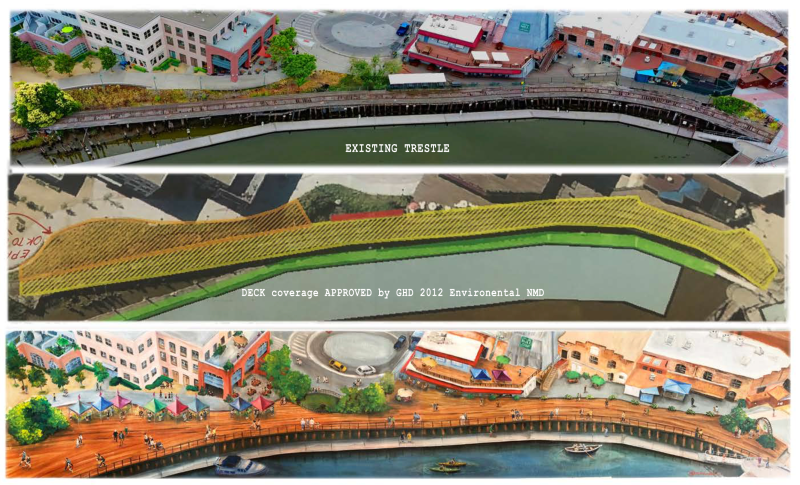
Image Christopher Stevick and original art rendering by Elle Lichenstein
The Historic Downtown Rail Trestle is as Californian as any of the staunchest pioneers of the old Wild West. Its story is thoroughly entrenched in the history of the city of Petaluma. Three decades before the advent of the interstate highway and the trucking industry, the Trestle structure was built on the banks of the busy Petaluma River in 1922 to link the bustling water-based and rail-based forms of travel and goods movement.

Image Petaluma Museum
Significant debate exists as to whether the historic structure should be reinforced while leaving as much of the original material in place for historical value or completely removed.
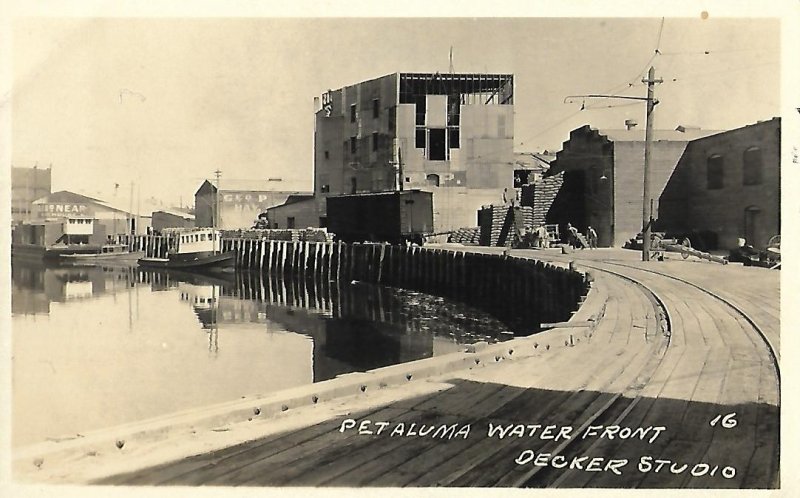
Image Petaluma Museum
The structure itself is the original redwood members. No original plans for its structure exist, but an Historic Structure Report shows its piles arranged in bents reinforced with cross bracing and caps that are a typical trestle construction design of the time.
It carried the weight of a freight line that transferred fresh produce and other goods from the agricultural fields north and west of Petaluma to heavily-laden steamers and schooners that traveled the slough waters south into San Francisco Bay. It was these tracks and Trestle that enabled Petaluma to serve as the “Egg Basket to the World”.
The restoration of the Trestle undisputedly has the potential to offer huge community benefit today, both as an economic catalyst for a river town in need of increased outdoor public space and a positive response to the challenges of recent years. What a major aesthetic boost it would be.

Image 2015 Rendering by Robert Frank — Heritage Homes of Petaluma
It sits adjacent to the Turning Basin in the historic downtown area, as a breakwater in a 90 degree bend and built above the river which is considered State Land, parallel to the tidally influenced channel of mixed stream runoff and bay water. The river fluctuates as much as seven feet with the changing tides.
The Trestle structure is owned by the Sonoma Marin Area Rail Transit (SMART). And this important part of the riverfront represents a multi-use path between SMART and downtown as more people ride the train into Petaluma for business and leisure use.
It’s important to note that as more time passes and no action is taken, costs will undoubtedly continue to escalate and vital funding opportunities may pass.
On a blustery May Day, in 2021 The Petaluma River Promenade Save The Trestle Organization, spearheaded by ‘Good Eggs’: local preservation and restoration contractor Christopher Stevick and community activist/musician John Maher (aka Petaluma Pete) recorded its Pianos of Petaluma Expo in an event that took place outside of the Petaluma Arts Center.
Stevick and The Petaluma River Promenade Save the Trestle Organization have and continue to campaign heavily for its full restoration as opposed to removal and replacement. Though many Petalumans fondly remember the last of the trolley-era along the Trestle and as an outdoor gathering space for many boating and river festivals, there is no longer any push to bring trains back along the historic structure.
Although Stevick’s research shows that reinforcement of the structure would be substantial enough to carry the weight of a trolley and this was his dream and goal for many years, any rehabilitation will now be for pedestrian use only. In its heyday, the Riverfest attracted thousands of visitors.

Image Petaluma Museum
In attendance in support of the Trestle rehabilitation project along with Stevick and Maher last May was former U.S. Representative, Lynn Woolsey, Petaluma Mayor, Teresa Barrett and Petaluma Downtown Association and Visitors program director, Marie McCusker.
Woolsey spoke of the importance of the Trestle. “We have to remember that and push for it,” she said.
And in Mayor Barrett’s words: “I really think this is the time for the Trestle”. She spoke of having succeeded in having the river dredged and the vitality that riverfront restaurants brought to the city during the pandemic with outdoor waterfront dining. The Trestle, she added, is a part of this renewed riverfront energy and would, if rehabilitated, provide a huge area for public events and gatherings.
McCusker also spoke of her belief that the Trestle will be revitalized. “We are an amazing community of people who are so engaged, who care so much about their civic responsibility but also the history of their town,” she said. “It (a river promenade) will be an outdoor space that puts us on the map — we have something that sets us apart from other Sonoma County towns — a river. The Trestle is part of our coming back.”
“Shovel ready plans have been on the shelf since 2013,” explained Bill Rinehart, vice chair of Petaluma’s Historic and Cultural Preservation Committee (HCPC), almost a year after the last big public event. “Yet, there is still important groundwork to be done and it can’t be ignored for another two years”.
“The Trestle stands as a monument to inaction and frustration rather than a source of great community pride and a hub of civic activity,” he added. “This structure served as the backbone that enabled our region’s industry to prosper and connect with the entire world. It has the potential to again be an economic catalyst, but this will require vision and action”.
His wife, Katherine J. Rinehart, consulting historian, author, former manager of the Sonoma County History & Genealogy Library and Sonoma County Archives and co-chair of the Advocates for the Sonoma County Archives has championed the Trestle rehabilitation since it was first introduced. It was Rinehart who has created impressive content of signs and photographs for educational components to be included in the promenade, which would serve to inform Petalumans, school children, environmentalists and visitors alike as to the rich history of the riverfront, with an added illustrated lesson as to the important role of habitat restoration.
Availability of a storm water runoff outlet under the Trestle lends itself to a permanently installed demonstration to educate the community to the results of their actions upstream.
The Rineharts are amongst many residents and activists who urgently recommend the City’s consideration of “Local Landmark” designation for this and other of Petaluma’s most significant and character defining historic resources.
One of the biggest hurdles facing the crumbling Trestle is its transfer of ownership title from SMART to the City of Petaluma. Next, the City would need to prepare contract documents for bid and confirm all permits and entitlements so that critical grant funding chances are not missed.
Council Member Kevin McDonnell is pushing hard for a rebuilt Trestle. Speaking of the many benefits it would bring to the community he highlights its role in recreation, transportation, also addressing its role in local Climate Emergency goals, business area improvement, sense of civic identity and not least, significant blight removal.
Petaluma’s General Plan, adopted in May 2008, provides guidance to “preserve and enhance Petaluma’s historic character” and “provide for a range of attractive and viable transportation alternatives, such as bicycle, pedestrian, rail and transit”. Furthermore, it addresses a requirement that the City’s unique identity and sense of community, history and place be retained by maintaining landmarks and aspects of Petaluma’s heritage by reinforcing the industrial nature of the city by adaptively reutilizing, reusing and preserving industrial landmarks such as the Petaluma & Santa Rosa Railroad Trestle.
The General Plan policy further defines the consideration of historic structures by encouraging and supporting the rehabilitation and development of structures reflective of the history of Petaluma’s rich agricultural and river-oriented industrial past.
And yet: “At the council goal setting session months ago, the Mayor and I tried to get the Trestle listed as a top priority, the council did not list it,” McDonnell said.
McDonnell will be pushing hard with this agenda again in a council workshop scheduled for March 14th.
Second District Sonoma County Supervisor David Rabbitt commented that: “As Chair of SMART, the railroad has already committed to working with the City on the Trestle — whether it’s restored with tracks or not . . . no one entity has the funds to handle the project alone, but SMART, Petaluma and hopefully the property owner of the Mill (who will benefit greatly) all need to work together and seek funding.”
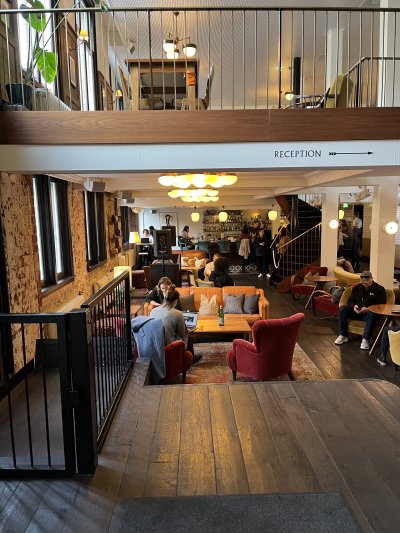
The Historic Petaluma Mill fronts most of the length of the Trestle and has been converted through adapted reuse from grain processing and warehousing to a mix of retail and business services. The Trestle structure begins on the south end at the Petaluma Yacht Club and ends at the north end at the Water Street Plaza. Completion of the Trestle would double the riverfront open space in the historic downtown area.
Newest committee member of the City’s Historic and Cultural Preservation Committee (HCPC), Alice van Ommeren became familiar with the history of the trestle when she found an old postcard for the book she and her partner co-authored: Petaluma in Vintage Postcards.
Van Ommeren has valuable experience having sat on a similar historic committee in Stockton. “The Trestle Rehabilitation has been a high priority for the HCPC for several years,” she explained. “This past year that priority for us was flagged as “may be recommended to move forward in the future, but there are legal, process or resource questions that need to be resolved before it can move forward.”
She also explained how a 2010 report resulting from a $500,000 study to analyze the structure and develop a design for the restoration now needs to be reassessed before seeking funding. The cost to rehabilitate the trestle, she said, is estimated to be about $6 million.
“I believe the Trestle Rehabilitation is one the most important historic projects on Petaluma’s plate that needs to keep moving. A lot of work has already been done and it’s a project that would get wide backing from community, business, etc. The feedback provided to the City by the HCPC related to the Trestle rehabilitation, includes its assignment as a City project with City staff liaison assigned and understanding that the overall project may be longer term than the next two-year goal setting period.
The Trestle will continue to orient our community towards our most important asset, the river,” she added. “Petaluma is also a tourist destination and a promenade would greatly enhance our riverfront”.
Petaluma Promenade Organization’s Christopher Stevick has invaluable experience hands-on in significant restorations on numerous historic structures including St Vincent’s Church, the restoration of Hotel Petaluma, the Carnegie Library/Museum and the removal of the fake façade on the Petaluma Blvd. Sienna building.
“Regarding the Trestle I was constantly told by City staff that my presence was not needed, but I would not go away,” explained Stevick, in sharing his determination to see the Trestle rehabilitation come to fruition.
His frustrations with the Trestle being delegated to what he refers to as “Never-Never Land” run deep. “My demonstrations like “This Place Matters” on the Trestle have been under-reported along with the benefits of having an iconic and cultural, central and truly historic destination for all Petalumans that supports our downtown,” he added.

Image Frances Rivetti
Stevick’s extensive stack of documentation dates back to 2010 and contains email exchanges, council presentations, city-based studies, correspondence and council approved goals. “But yet, it appears they have been approved then selectively ignored,” he lamented.
Still, they’re not giving up, despite the frustration.
John Maher has produced multiple videos to generate more groundswell support for the Petaluma Promenade Organization and Save the Trestle Team.
Business owner Margo Gallagher of Vibe Gallery downtown believes that so much of the charm and beauty of small-town Petaluma has been taken away as it grows as a city. “I’m all for preserving the historic Trestle or anything else we can hold on to before it’s too late,” she said.
Yet with no clear lead it appears that it falls to the City ultimately to take a leap of faith and move things forward with SMART.
Bill Rinehart further explained how in his opinion, City Manager Peggy Flynn has done a “fantastic job” in checking off many of the core items on the City’s vision and priority goals list that were identified during council workshops of the past two years.
He reiterated what his fellow committee member, van Ommeren said: “The Trestle didn’t make the cut in the last round, but things have changed and it’s time to generate renewed enthusiasm,” he added. Rinehart is of the belief that the Trestle is now poised to move on up to its rightful place at the top of a new list of fixers to be identified by the council in a workshop scheduled for March 14th, 2022.
“It’s the City Manager and the Director of Public Works who can move forward on this but they can’t take action until more council members get behind it,” he added. “It’s important for people to know that this rehabilitation isn’t going to syphon off money for other key budgetary items that are pressing within our community — tapping into Federal funding offsets as a part of a SMART multi-use project will not detract from other city-wide problems that need to be addressed.
Quality outdoor space has never been more important and this is just the sort of project that can help Petaluma adapt to changing economic and social norms.”
If the structure is lost, it’s not known exactly what will happen, but reports cite that there is a risk of bank erosion beneath the historic waterfront buildings. The main storm water overflow for the western side of the City is located beneath the Trestle and removal of the structure may change how the runoff dissipation encounters the river, possibly further undermining the bank in this area.
If, however, the project succeeds, Petaluma’s downtown core will undergo a major revitalization that will benefit the community for the next 100 years.
If you’d like to see something done about the Trestle this year send a short letter of support for its rehabilitation to Mayor Teresa Barrett — tbarrett@cityofpetaluma.org and cc Vice Mayor Brian Barnacle bbarnacle@cityofpetaluma.org and council members D’Lynda Fischer dfischer@cityofpetaluma.org Mike Healy mhealy@cityofpetaluma.org Dave King dking@cityofpetaluma.org Kevin McDonnell kmcdonnell@cityofpetaluma.org and Dennis Pocekay dpocekay@cityofpetaluma.org as well as Petaluma City Manager Peggy Flynn — PFlynn@cityofpetaluma.org and Public Works Director Christopher Bolt cbolt@cityofpetaluma.org
And if you have a strong opinion with regards to the Trestle, drop a note to the editor at the Argus Courier and/or Press Democrat, too. Public is welcome and encouraged to speak during the “Public Comment” section of each agenda item during the March 14th Petaluma City Council evening meeting.

Image Frances Rivetti





My understanding about delay in improvement is a threeway pointing contest among SMART, Northern California Railroad (?) and the Union Pacific (successor to the defunct Southern Pacific Railroad) as to who built and who owns the structure, leaving the City with no partner to negotiate with. I certainly hope SMART is willing to step up.
Posted by: Harry Nieuwboer | Sunday, February 20, 2026 at 10:33 AM
It sounds like now is the time, Harry. I hope we get to see some action on this soon if the City agrees to make it a priority on its goals list.
Posted by: frances rivetti | Sunday, February 20, 2026 at 11:27 AM