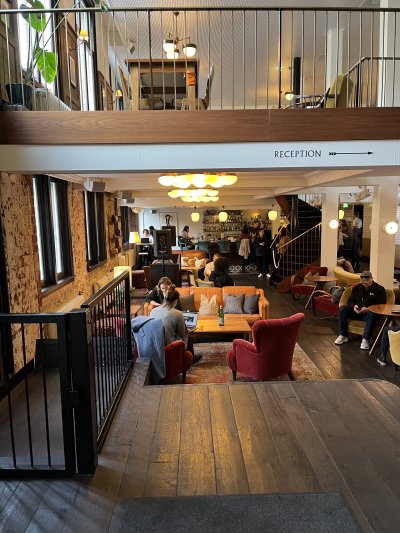
Whenever I am in London, I make a date with my dear friend, Bev, who I met in journalism school in Harlow, Essex in the late 80s. We pick out something special to do together for the day and given that Bev lives in the greater London area, something central is usually on the cards. This summer, we opted for afternoon tea at stylish and super-view positioned Swan on the South Bank by the Thames for lunch, followed by an equally memorable matinee performance of A Midsummer Night's Dream right next door at Shakespeare's Globe theatre, Bankside.
Located at the iconic Shakespeare’s Globe, Swan is a stunning Bar and Restaurant set over two floors, with great views of the river and St Paul’s. It's open all day serving modern British food, high tea and available for morning breakfast to evening cocktails and everything in between. Despite its touristy location it's a smashing spot to celebrate something fun or special, or just to hang out. A proportion of the revenue from Swan goes to the Shakespeare’s Globe Trust, a charitable organization set up to further the experience and international understanding of Shakespeare in performance.

How could we resist? Swan’s A Midsummer Night’s Dream afternoon tea is inspired by the journeys of the characters: from the pea flower of Oberon’s love potion, the apricots Titania feeds to Bottom and mulberries from the lovers’ tree.

Love may not look with eyes, but beautiful traditional tea treats, presented on bespoke crockery designed by Annika Wester, are almost too pretty to tuck into. If you go, for tea or other refreshments at Swan, click here.

No photos are allowed during performances in the Globe, but the school groups who were enthralled by the modern, upbeat and creative production of A Midsummer Night's Dream were clicking away on their phone cameras before the show started, so I snapped a couple of quick pix to show you how fantastic the reproduced Globe truly is. I have toured a couple of times with the boys when they were younger, but never had the time to catch a full performance. It was well worth the wait!

Go London described the producers as having: "created a carnivalesque atmosphere, with fairyland an explosion in a neon-coloured dressing-up box." And The Guardian: "The fully populated stage looks like the clean-up operation after Pride. Bafflingly, fairy queen Titania lives in a flower-laden recycling bin, her fairies resemble the results of a hurricane in a craft show, and Bottom’s ass is a papery rainbow piñata. The direction is sometimes scatty and the fairy scenes feel like filler, rushing through the words in favour of visual spectacle."
But I thoroughly enjoyed it and so did Bev. We thought it was brilliant in that the hundreds of school kids in the largely open-air audience were thoroughly enthralled and rapt by this up-to-the-minute take on one of Shakespeare's most fantastical tales. And isn't that just as fantastic in this day and age? None of them were looking at their screens once the cast took to the stage. It helped that the whole cast could sing and contemporary music made it all the more compelling for those who might otherwise have wished they were anywhere other than stuck in a theater watching Shakespeare.
If you go, plan your visit ahead of time by clicking here.

This landmark attraction along the South Bank is actually the fourth reincarnation of what was Shakespeare’s original theatre. London’s first purpose built theatre was on Curtain Road in Shoreditch in the 1500s, and named “The Theatre”. Shakespeare began his writing career in earnest and his earlier plays were performed here.
The Bard and his company are believed to have run into trouble with their landlord and were forced out of the The Theatre until one of the group spotted a loop hole in their contract and discovered they actually owned the wooden structure. A plan then emerged. According to info on the Swan's website, it was over the Christmas holidays while the landlord was away that Shakespeare and his company literally stole the theatre over the course of four nights and when the weather improved and the river Thames thawed they floated the timbers across the river on barges, over to the Las Vegas of London, Bankside, on the south side of the river.
It took seven months to rebuild The Theatre, renamed The Globe, presumably so no one would notice they’d stolen it. The Globe ran from 1599 until 1613 until an incident involving gun powder and other over-zealous special effects caused the theatre to burn down during a performance of Henry VIII.
The replacement Globe was rebuilt within a year, however this time with a tiled rather than thatched roof. Although Shakespeare died in 1616 the Globe continued without him until the 1640’s when the puritans took hold and all the theatres were pulled down.
It wasn’t until the 1940’s when American actor and visionary Sam Wannamaker came to London and was shocked to find nothing but a small plaque to commemorate Shakespeare’s work in London that a decades long campaign was launched to rebuild the Globe, which finally began in the early 1990s. Shakespeare’s Globe Theatre that we know today, the fourth of its kind, opened in 1997, half a century after Wannamaker’s campaign began.