One heck of a story came my way via a fellow Petaluman who texted me late one evening just as the new George Clooney movie The Monuments Men was about to hit the big screens here in Northern California.
Though Matt wanted his family story shared with his community (as his Mom and Aunt had also done that same week, in their mid-Western and Nevada communities), this was, to say the least, somewhat of a more substantial article to squeeze into my regular Petaluma Argus Courier South County Notebook Column.
We broke the story in the Argus on the front page a few days later, just after the movie opened. Due to the newspaper's space allowance on an unusually busy week, quite a few parts of my humble account of this incredible story never made it into print.
It's too, too rich with history and intrigue not to share. So pull out a chair, sit yourself down and imagine yourself stumbling across the biggest stolen treasure stash in history...
Hollywood A-list actor, writer, director, George Clooney draws a global audience to his cinematic offerings, even when a made-to-be blockbuster movie is met with somewhat lukewarm acclaim. Reviews of The Monuments Men, Clooney's February 7th 2014 release, have largely panned his big-screen, cinematic making of one of the greatest treasure hunts in the history of the world. The Detroit News went so far as to describe it as: "A Monumental Bore."
What's to be expected when a much anticipated war movie takes an all-star liberty with historical facts? Still, it seems a great waste of talent, time and money when the real story might not be star-studded, but was so darn good.
Starring alongside Clooney, his dream team of Matt Damon, Cate Blanchett, John Goodman, Bill Murray and Hugh Bonneville are a concoction of characters based on members of The Monuments, Fine Arts, and Archives program, established in 1943 and tasked with protecting cultural property (mostly historic monuments) during and after World War II.
Digging deeper into fact over fiction, the real-life hero of this remarkable story was in fact, unsuspecting U.S. Army Major Ralph Emerson Pearson, whose grandson, Petaluma resident, Matthew Crysdale, has quietly celebrated, his whole life.
It was Victory in Europe, V.E Day (May 8th, 1945), an epic moment in time in which Germany's surrender to the Allied Forces of World War II had just taken effect.
"Task Force Pearson (named after its front man, my grandfather) had set out that same day (under instruction by Monuments Men in the region) to uncover an unknown quantity of art treasures (thought to include the Hungarian Crown Jewels) and to liberate Austrian locals at the salt mines at Alt Aussee, some 75 miles east of Salzburg," said Crysdale, a father of three and gaming executive Art Director with Novato-based Visual Concepts .
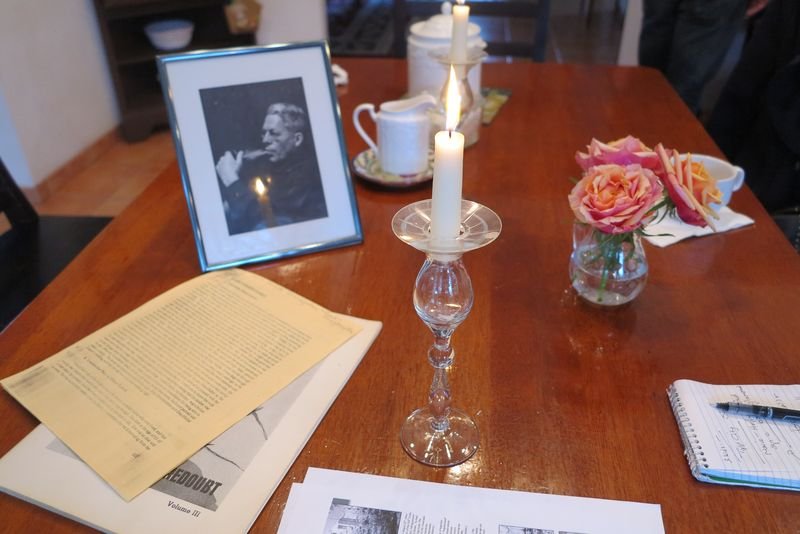
Crysdale's grandfather, then Major in General Patton's Third Army's 318th Artillery (sent to liberate Germany), recorded the setting of Alt Aussee in his 1957 self-published book 'Enroute to the Redoubt' as: "The peaceful lake and mountains of an Alpine resort - refuge for half the wanted men in Europe and the hiding place of Hitler's loot and property stolen from the oppressed peoples of Europe."
Austria contains immense salt deposits and the scenic resort community that would take center stage with a phenomenon find had been a popular tourist spot before the war.
The Nazis in the area were by now desperately scrambling to escape their stronghold in the area, after concocting an elaborate plan for multiple explosions in the salt mines, designed to destroy the entirety of a priceless, hidden treasure trove to prevent its recovery by the Americans.
"At 1000 I was alerted.... to seize the town and bring back the crown jewels and missing Rembrandt paintings," wrote Pearson, who after having retired as Colonel, would go on to become a city commissioner in Middletown Ohio, an avid historian, author and leading U.S. genealogist. His book, written over a decade after the end of World War II was named for one of Hitler's infamous hideouts and is, in itself, a treasure trove of facts and figures, maps and photos, painstakingly compiled from old carbon copied records.
Alt Aussee was located some distance from where the U.S. had any troops. Very little was known of what the situation might be. "Certainly no one anticipated what would actually happen there," wrote Pearson in his detailed, five-volume account. Initial plans had been for a handful of mild-mannered members of the Allied Special Forces art history expert section known as the Monuments Men to retrieve whatever loot they found and bring it back that same day.
Third Army officials, though, wisely decided that 2nd battalion infantry troops should be sent on the four hour, mountainous trek, along with a front man, Major Pearson, traveling in jeeps and a one-and-a-half-ton truck. This intrepid contingency was worried that perhaps the German forces in the area had not been informed of the cessation of hostilities, many of the Nazi troops being black-uniformed elite SS corps and more than capable of carrying on their own personal war.
According to Pearson's account, a large gathering of Austrians had been anxiously awaiting the arrival of American troops at Alt Aussee, on May 8th, having feared late action by the Nazis. On his arrival, Crysdale's grandfather met with the town's most prominent citizens, who subsequently outlined a vast scale of treasures that had been brought by the Nazi's to be stored in a salt mine high above the village.
After the immediate arrest of 'Grave Digger' Gauleiter Eigruber, an Austrian-born Nazi Officer (later hanged by the Allies for his role in the concentration camps) in the village, along with his guards, Task Force Pearson headed north to the mine, where the Major met with Dr. Hermann Wilhelm Michel, Director of the Museum of Natural History in Vienna and Dr. Max Eder, chemical engineer, in charge of the mine.
"I replaced the German soldiers at the mine with guards from our own group, " wrote Pearson, viewing the closed entryways to the galleys where the art was stored. "The interior approaches are a honeycomb of passageways," he wrote of the cavernous one kilometer long, 300 meter wide mine.
Dr. Michel described the collection in detail to the astonished Major, estimating it as being worth over $500,000,000, although much of what was there, enough to fill several museums, was considered priceless. Mine workers had duly explained how they had swiftly sealed all six entrances to the area where the art was stored in order to protect the inner collection from being destroyed by the Nazis.
"Deep in the mountainside, it turned out, was located one of the greatest collections of art ever assembled," wrote Pearson. "The looters working for Hitler and Goring, had done a big job. The art, collected from at least fourteen countries, occupied by the Nazis, had been scheduled for destruction to prevent its 'desecration' by the American forces." SS Troops had transported eight boxes, marked 'marble, don't drop'. "Had their contents been detonated, as planned, the art would have been destroyed".
In a later video recording commemorating World War II, a charismatic and articulate Colonel Pearson (who passed away at age 86, in 1991) described this incredible find as having prevented: "What would have been a terrific catastrophe, a great tragedy."
Newsweek in 1945 reported that some 5,350 old masters were amongst the art treasure trove, an astonishing collection of 21,903 items including 14,000 paintings, priceless coins, 17th and 18th century furnishings, rugs, tapestries, armor, historic books and manuscripts, altar pieces and sculptures.
This was wartime looting on an unprecedented, industrial scale. It would take some two-and-a-half months to remove from one single, accessible tunnel. As the Fuhrer had attempted to conquer the Western World, his armies had methodically pillaged much of Europe's finest art, from Michelangelo and Da Vinci to Van Eycks and Vermeers, ruthlessly stripped from homes, galleries, museums and churches across the continent.
After informing his Monuments and Fine Arts Officer contact (one Captain Posey) by radio, of his find, Pearson called for necessary rations, gas, supplies and troop reinforcements. Meanwhile, hundreds of German soldiers and vehicles were on the roads, still armed despite having surrendered. Thousand more Elite Guard troops were believed to be hiding out in mountain passes, ready to fight to the death. According to Pearson's account : "Highlight of the period was the surrender of General der Panzer Truppe Balck at Garsten, Austria. Over 32,000 POW's were captured that day."
On Monday, May 14th, 1945, The Cincinnati (Ohio) Enquirer headlined the following: "Ohioan Grabs Nazi Cache! Middletown Major Finds Art Treasures Valued at More Than $500,000,000." Major Ralph E Pearson, high school track star and forty-year-old father of three was an unassuming hometown, national and international hero. "The irreplacable works of art were found in an Alpine salt mine near Alt Aussee," the report continued: "The entire collection of the famed Monte Cassino Abbey was found safe in the salt mine. This cache of art works makes all other findings nothing more than a drop in the bucket." The newspaper described the Nazi treasure hoard, hidden nearly a mile under the earth, as the cream of Europe's art wealth.
The salt mine contained invaluable paintings from the Church of Notre Dame at Bruges (Michelangelo’s Madonna of Bruges), artworks from the St. Florian Monasteries, the famed Ghent Altar, the complete Rothschild Art Collection, as well as Hitler's personal library.
Even The Smithsonian Magazine reports that Monuments Men Captain Robert Posey and Pfc. Lincoln Kirstein were the 'first through the small gap in the rubble blocking the ancient salt mine', in an otherwise excellent true story feature article by Jim Morrison, released on February 7th, 2014. Yet, no mention of Major Pearson or his Task Force having been first on the scene. Without Pearson's account ever having been published, this 'monumental' historical find, would, in effect, have been entirely rewritten.
"Hitler himself was a frustrated artist, rejected twice by the Academy of Fine Art in Vienna" said Crysdale, whose mother, Charlotte, a now-retired military map maker, illustrated the covers of her father's account of this incredible find.
Crysdale recalls his tall, broad-shouldered grandfather's story telling prowess with fond recollection of regular childhood visits to Pearson's final home, in Austin, Texas. "I have grown up with this my whole life," said Crysdale. "I knew not to expect a ticket to the movie premier, but I was happy that the release of The Monuments Men has prompted me to share the real facts of the story once again with my own children and now with my community."
As one of seven siblings, Crysdale considers himself part of a family of historians. The family is not offended by Clooney's take on the story. "It's Hollywood," said Crysdale. In addition to his precious, personalized copies of his grandfather's book, he also has a number of the war hero's most personal possessions in his care. "He took time to treat each of his grandchildren to a first experience, as we were growing up," said Crysdale."Mine was a first ride on a city bus!"
Crysdale's Aunt currently houses the family's most prized possession - a painting of her late father by Boleslaw Jan Czedekowski, a Polish painter who was forbidden to paint by Hitler. The painter was in a town that was liberated by Pearson and he was so grateful to the major that he made a start on a portrait, but did not finish it. After the war, the unfinished tribute painting was presented to Pearson in Washington D.C. and has made its round amongst Pearson's offspring since his passing.
Author of the 2009 book The Monuments Men, oil man-turned stolen art expert and author Robert Edsel, has created a Monuments Men Foundation for the Preservation of Art, a non-profit to safeguard the legacy of the treasures of Alt Aussee and to help complete the on-going mission of returning thousands of still missing treasures to their rightful owners.
The story of The Monuments Men is also to be featured in a major gallery inside The National WWII Museum's upcoming Liberation Pavilion, in New Orleans.
"This gallery will be a journey into the heart of the greatest treasure hunt in history," wrote Edsel in a release on his website. "I couldn't be more proud than to have it at The National WWII Museum in New Orleans, the official WWII museum of the United States and a world-class institution." Edsel has been an active member of the Museum's Board of Trustees since 2010, and the exhibit has been in development since 2011.
The gallery will allow visitors to expand their knowledge through an immersive experience that brings the missions of these previously unsung heroes to life. Scheduled to open in 2016, the gallery will lead visitors on a journey with the Monuments Men (with hopefully at the very least a nod to Task Force Pearson) as they make their way through the Austrian salt mine to recover priceless works of art.



Comments