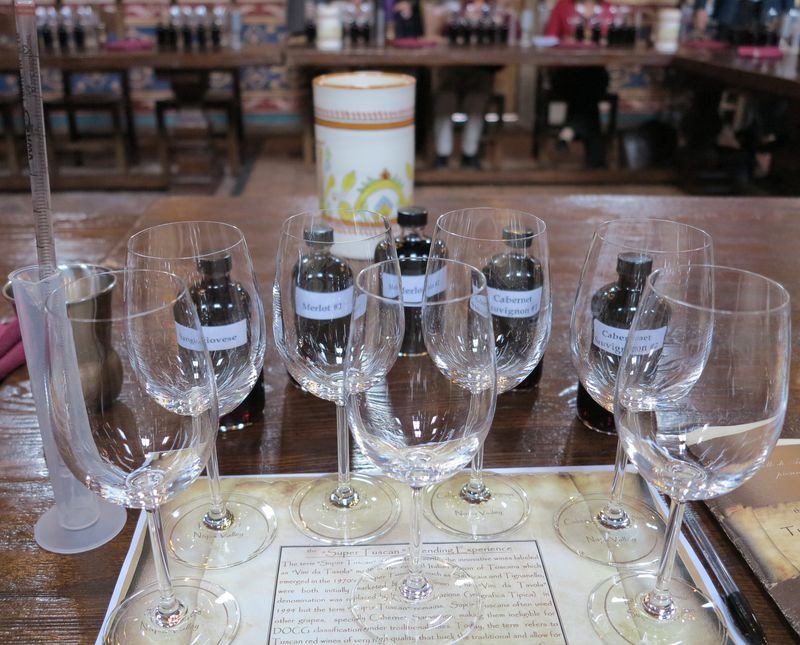
 Now that I have had the opportunity to play around with my own custom blend for a 'Super Tuscan' red suited to my very own personal palate, I'll be paying a lot more attention to the blending percentages of wines I pick up in the store.
Thanks to an outstanding treat of a field trip this Fall to the great hall of the Castello di Amorosa, in the North of the Napa Valley, my knowledge and awareness of what makes a great 'Super Tuscan' underwent a substantial upgrade in both education and taste.
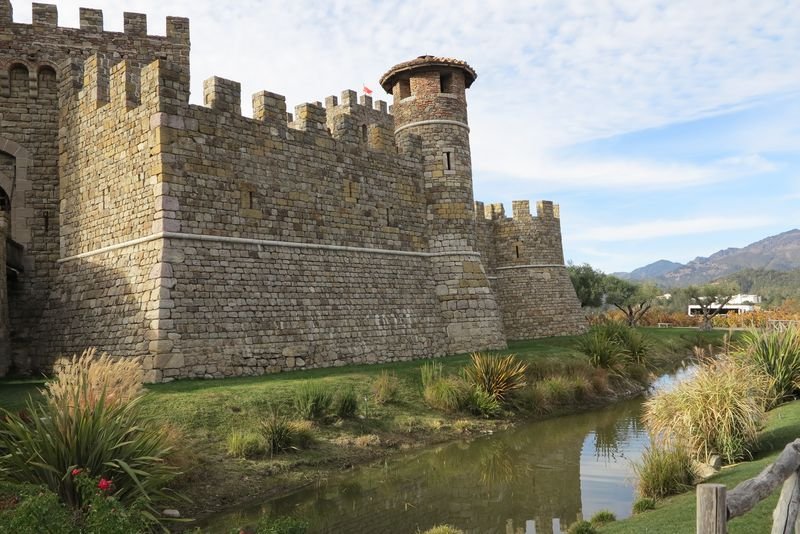
If you've yet to visit Dario Sattui's jaw-dropping authentically built and styled, Medieval Tuscan-style Castello di Amorosa, not far from Calistoga, in the Napa Valley, you won't instantly recognize its great hall as one of the most original venues in wine country. For those who have already toured this stone-made extravaganza, you'll appreciate my excitement in getting a hands-on lesson amidst the frescoes in 'Super Tuscan' wine blending techniques.
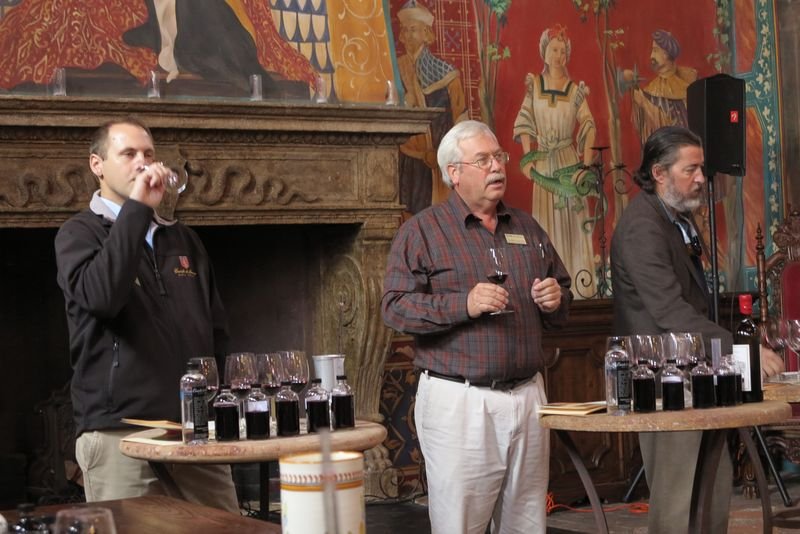
Director of Winemaking, Brooks Painter (pictured below center), was Winemaking Operations Manager at Robert Mondavi Winery prior to bringing his three decades plus of winemaking experience in the ultra-premium varietal market to Castello di Amerosa, in 2005.
Brooks and Associate Winemaker, Peter Velleno (pictured below left), instructed guests on the steps to take for Super Tuscan blendings, encouraging creativity and comparing of tastes, aroma and mouthfeel.
Though the types of wines made here include Pinot Grigio, Pinot Bianco, Chardonnay, Gewurtztraminer, Rosato di Sangiovese, Red Table Blend, Sangiovese, Pinot Noir, Barbero, Primitivo, Merlot, 'Super Tuscan' Blend, Cabernet Sauvignon, Muscat Canelli, Late Harvest Gewurztraminer and Late Harvest Sauvignon Blanc/Semillion, the Castle's wines that we would be playing with in this particular blending session were the house Sangiovese, Merlot (two), and a couple of different designates of Cabernet Sauvignon.
During our blending experimentation, Brooks and Peter introduced us to the Castle's Consultant Winemaker, Sebastiano Rosa (pictured below right), on-site for just a few days, from Italy, en-route to China. I considered myself extremely fortunate to hear one of the Italy's most respected winemakers speak in person, in front of such a small, intimate group.
Sebastiano shared two phenomenal wines that he had brought with him from Italy, his Tenuta San Guido Sassicaia Bolgheri 2010 - 85% Cabernet Sauvignon and 15% Cabernet Franc.
Sassicaia, I learned, means "the place of many stones", in reference to gravel soils. The first to be dubbed "Super Tuscan", Sassicaia as a wine, made its debut in Italy in 1968 and became so successful, it earned its own appellation status in 1994.
Sebastiano explained how this came about. His grandfather was the first to have begun blending Bordeaux varietals with Tuscan wines in the 1950s. "An English journalist visiting Tuscany in the 1960s tasted it, considered it fantastic and on his return, wanted to know if he could describe it in print as Super Tuscan," he said.
Tuscan wines are lower in alcohol than their California cousins. This is a taste that suits me and I found the Sassicaia to be exquisite, with its complex aromas of red and black fruits, notes of wild herbs and spice. Aged for two full years in French oak barrels, this is a wine that will age splendidly and perfect for pairing with my favorite braised meats and hard, Sonoma coastal cheeses.
Growing conditions are so different in Tuscany when compared to Northern California wine country, particularly the Napa Valley. Though we frequently describe our region as being similar in so many ways, winter temperatures typically remain quite cold (and snowy) in Tuscany through the end of March. Chilly Springs and heavy rains until May make for quite a contrast, with Autumn arriving by early September.
The second of Sebastiano's wines shared with this lucky little group was a Sardinian Agricola Punica Barrua Isola dei Nuraghi, which finds its ideal terroir in the warmer, well exposed Sardinian terrain. First released in 2002, deep, ruby-red, full-bodied Barrua offers intense aromas and the sorts of fruity, herb and spice flavors of the Sassicaia, yet distinctive with its Southern, maritime influence.
Whereas wines along the foggy Pacific Sonoma Coast are cool climate, Sardinia's coastal climate brings in a contrasting cloak of Mediterranean warmth.
It didn't surprise me one bit to hear Sebastiano describe these wines (in all their $180 U.S. retail price glory) as more than a little bit renegade. Italians, after all, do like to make up their own rules as they go along, and the strict requirements of so many Old World wine regions make the fact that his family was the founding source of a new trend in Italian (and world) wine making, something to celebrate.
I learned that it is fine to play around with the blending process and to have some fun. Winemakers get to do this and though they do tend to return to a similar proven formula, percentage-wise, in blended varietals, each year's vintage plays a part in just how those blends perform.
Also, a whole lot hinges on how well the various elements of a blend will hold up to the test of time. I've heard from several wine industry insiders that custom blending of wines when not properly controlled with compatible wines for storage and aging, can be a bit of a nightmare, so I wouldn't recommend it as an activity to pay for if you'll be taking it home, unless you are participating in a blending event such as this, with premium wines that have been proven to produce a quality, durable vintage.
To inquire about upcoming Blending Seminars at the Castle, call 707 967 6272.
Should you take a notion to blend your own 'Super Tuscan' at home, plan to drink it soon after.

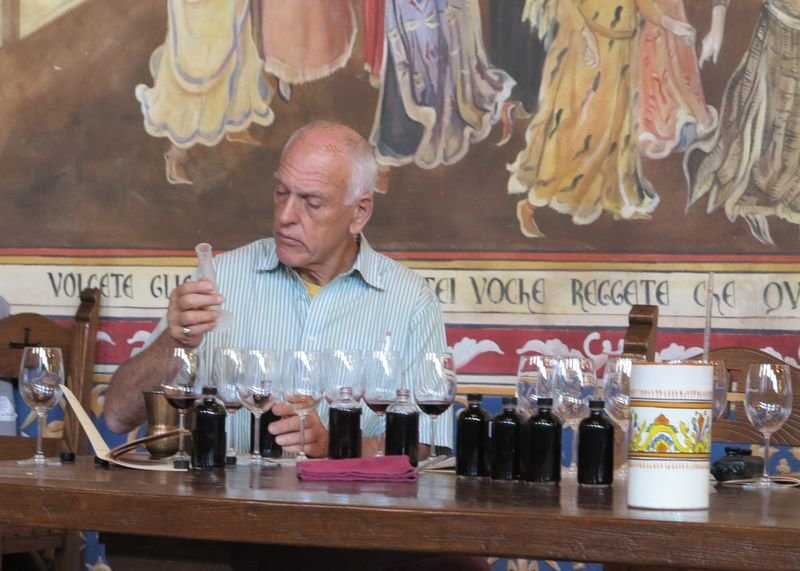
It took Castello di Amorosa owner Dario Sattui (captured concocting what I suppose I would have to describe as a one-off proprietor's blend for the occasion), decades of research, planning and studying medieval castles in Italy and other European countries, prior to the first stone set in the building of his 107-room, 121,000-square foot masterpiece, back in 1994.
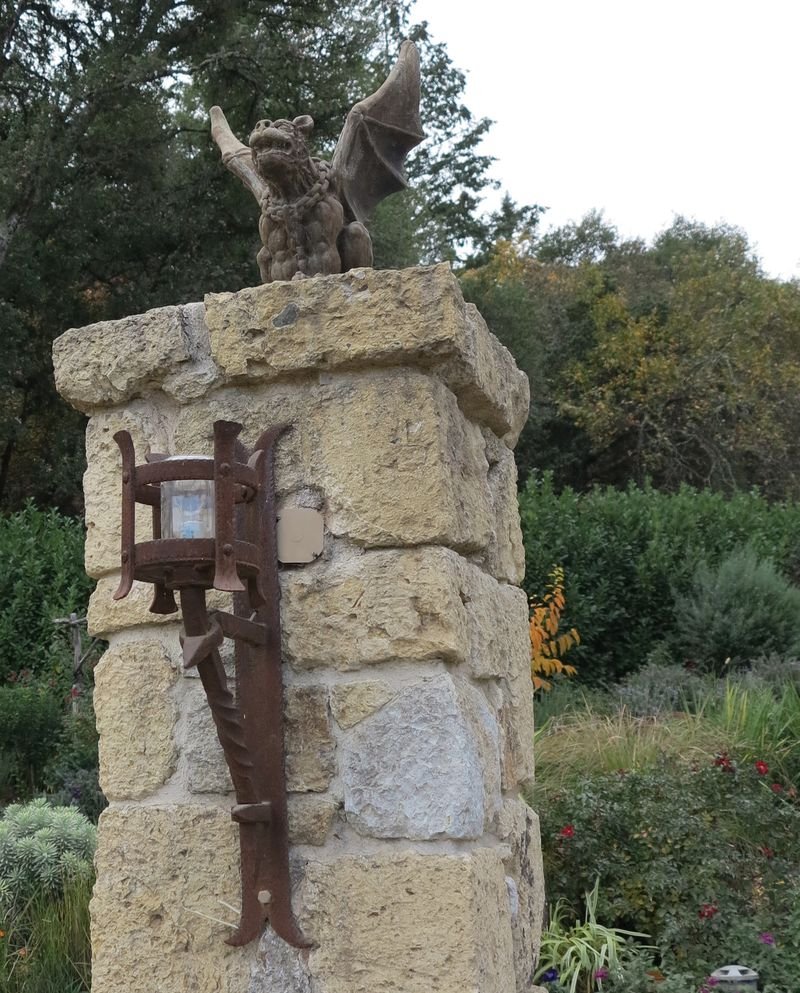
Can you imagine envisioning the creation of a four-story castle, incorporating some 8,000 tons of hand-squared stone, 900 linear feet of caves, 95 winemaking and storage rooms, a great hall with two-story Italian frescoes, defensive fortifications, ramparts, a drawbridge and a moat, dungeon (and torture chamber!), secret passageways, courtyards, loggias, a church, stables, oh, and, not forgetting, some 30-acres of estate grapevines?
If that seems like a tall order, even for the most imaginative wine country mogul, then you haven't met this one. Dario welcomed a select group of invited guests to the Super Tuscan blending with the warmth and friendliness that Castello di Amorosa has a reputation for amongst its dedicated scores of devoted wine club members.
The fact that every single drop of his wines made at the Castle are sold either on-site to hundreds of visitors flocking to the 13th Century Tuscan-style attraction, daily, or through its extensive wine club, cuts out the pesky, pricey distribution process and makes it a common place occurance for the Castle's wine drinkers to rub shoulders with its proprietor and winemaking team at frequent, fun gatherings and events.
This is a refreshing set-up for those who like to know who is making their wine and how.
I got the impression that Dario Sattui is every bit as partial to popping into his latest wine country landmark as the seemingly never-ceasing stream of tourists paying $34 a pop for a guided tour and taste.
 Most of us are well versed in the fine art of drinking good wine, but an experimentation in the blending process is a great way to learn more about the varietals we love.
I learned from this experience to take more time in smelling and initial tasting of the five wines at hand.
By holding the stem, I swirled the glass rapidly to increase the surface area of the wine and help it release its volatile chemicals into the air.
After the swirling part, I put my nose into the glass to inhale (yes, in this case, its imperative to inhale!) with a few quick, hearty sniffs. Don't be shy with this - its where the strength of the aroma comes through and offers the chance to check out any off-smelling elements.
At this stage, I let myself indulge in the wine detective's exploration of uncovering any floral, fruity notes and any other aromas that might come to mind. Think spices, pepper, tea, nuts and some of those other myriad crazy things you sometimes read about on the back of a wine label (tobacco, tar, mushrooms, hay...)
I sipped and let each wine move over my tongue so that its aromas reached my nasal passageway and back of my throat. The trick here, I've deduced is to attempt a sort of chewing effect, as if the wine were food.
If you're tasting during a work day or tasting a lot of wines, I don't have to tell you that I didn't indulge in too much swallowing, tempting though it was! After each taste, I noted how long the flavors stayed in my mouth and if there was an overbearing balance of any lingering alcohol.
Selecting which wines to blend and how much of each ultimately came down to a preference in color, clarity, aroma, taste and body. It took three or four different blends for me to find the one I liked best and I found it to be a 60% Sangiovese, 20% Merlot 1 and 20% Cab 2.
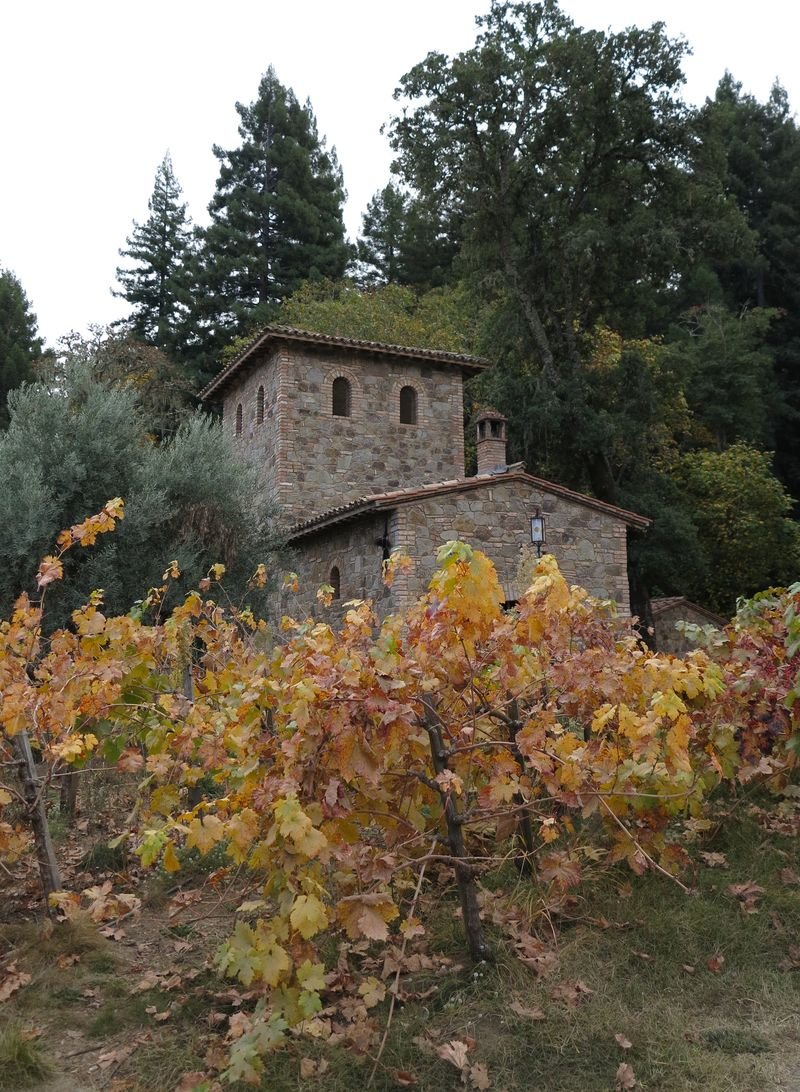
Blending seminars aside, Food & Wine Pairing events, Horse Drawn Vineyard Tours, Hiking Vineyard Tours as well as a Chocolate Pairing upgrade to the Castle's regular tour and tasting are frequently available. Open seven days a week. See website for more info.


Comments